Coffee trading on the ICO's figures showed no clear gain
Trading Arabica and Robusta futures on the ICO's world coffee balance showed no clear gain since 2016. USDA stocks and CONAB gave leads only.
The International Coffee Organization publishes a world coffee balance almost every month. Used on its own to buy or sell Arabica and Robusta futures, it showed no clear gain since 2016. Two other sources, US government world stocks and Brazil's crop surveys, gave leads, not proofs.
On 16 November 2026, the International Coffee Organization (ICO) published its October Coffee Market Report. It shows four years of world deficit, from 2021/22 to 2024/25, then a surplus of 3.0 million bags expected in 2025/26.
Anyone who holds Arabica or Robusta needs to know whether the world grows more coffee than it drinks. The ICO prints this balance almost monthly; the US government's world figures come twice a year. So we asked: can the ICO's balance guide positions in Arabica and Robusta futures, and do other supply figures do better?
The short answer: the ICO's figures showed no clear gain since 2016. Two other sources pointed the right way, but they are leads, not proofs. And the ICO's estimate for the newest crop now changes rarely.
Key takeaways
- No clear gain from the ICO. Trading on its balance gave a Sharpe ratio of 0.06 since 2016: a return per unit of risk close to zero.
- USDA world stocks did best, mostly through one position. A Sharpe ratio of 0.60, but most of it came in 2023–2024, from one bet on a rise.
- The ICO's newest-crop balance now rarely moves. It was revised in 9 or 10 reports a year from 2018 to 2021, and in none of the 12 reports of 2024.
Why a world balance should matter for coffee prices
The world balance is production minus consumption for a coffee year. A deficit means the world drinks more coffee than it grows, so stocks run down. A surplus builds them up.
Think of the world's coffee as one warehouse. A deficit year draws it down; a surplus year fills it back. The ICO's balance is the note on the warehouse door. If the note says the shelves are emptying, Arabica and Robusta prices should find support; if it says they are filling, prices should weaken.
That, at least, is the idea we tested. Other public figures describe the same warehouse. The US Department of Agriculture (USDA) estimates world coffee stocks twice a year, for all coffee. ICE, the exchange where both futures trade, reports its certified stocks: the coffee approved for delivery against the contracts. And Brazil's crop agency, CONAB, surveys the Brazilian harvest four times a year.
How we tested it
We gave each figure, one at a time, to AlphaGen, our calibration engine. AlphaGen used it as a signal to buy or sell Arabica futures in New York and Robusta futures in London. When a figure pointed to more coffee, such as a bigger surplus or bigger stocks, it leaned towards selling; when it pointed to less, towards buying. It never traded the gap between Arabica and Robusta.
AlphaGen was recalibrated every 20 trading days, and each result counts only data it had not yet seen. It acted one trading day after each new figure. The test starts in January 2016, a date fixed in advance; the ICO balance first traded in December 2017.
We measure each result with the Sharpe ratio: the yearly return per unit of risk, before trading costs. Zero means no gain. Each comes with a 90% range: the wider the range, the less we know.
After these first results, we added two crop measures: the growth of the newest crop over the previous one, from the ICO and from CONAB. A larger crop counts as a reason to sell.
The ICO's balance and crop estimates showed no clear gain
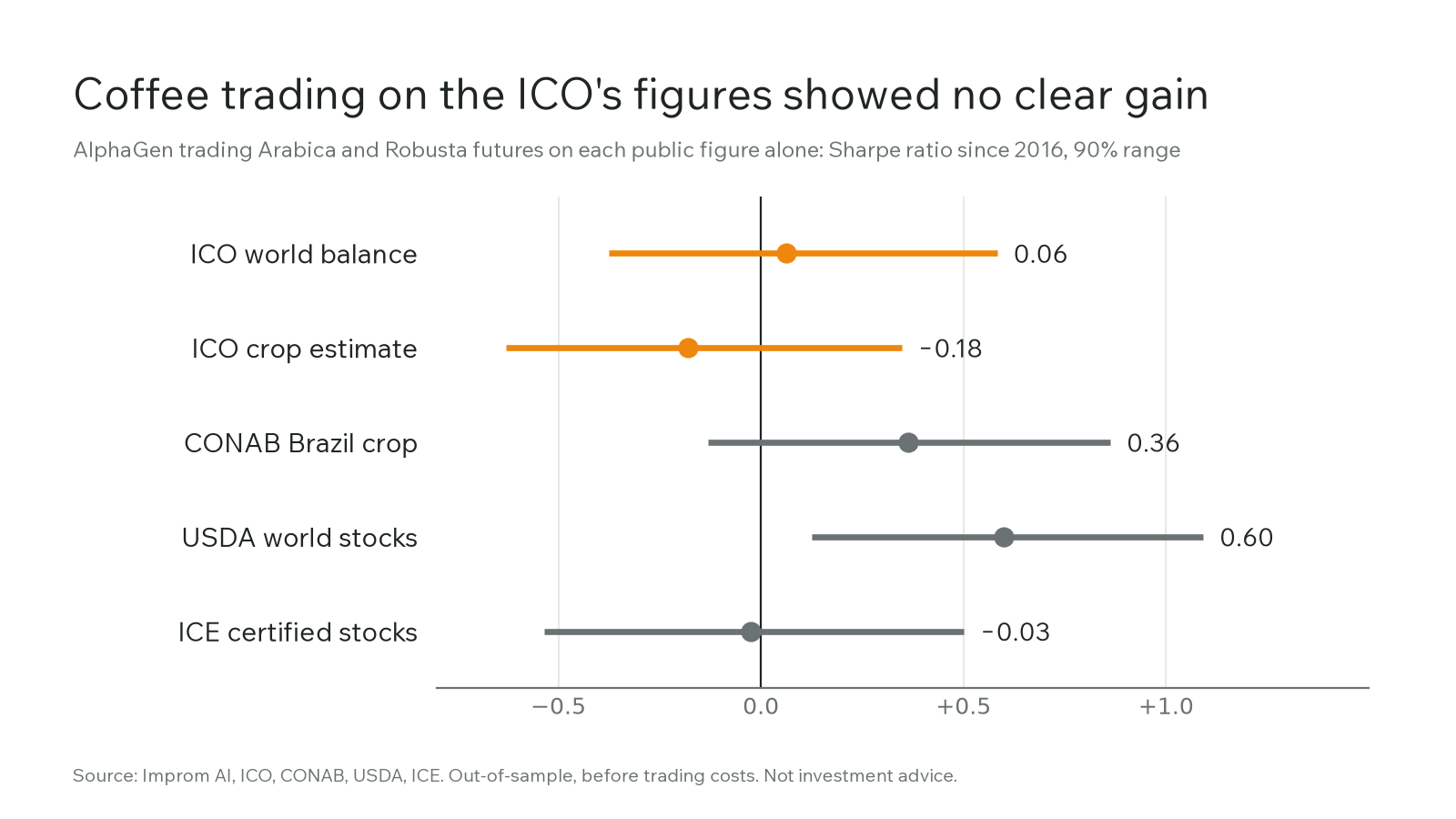
Dot: Sharpe ratio on data AlphaGen had not seen, January 2016 to November 2026; line: 90% range. Source: Improm AI, ICO, CONAB, USDA, ICE.
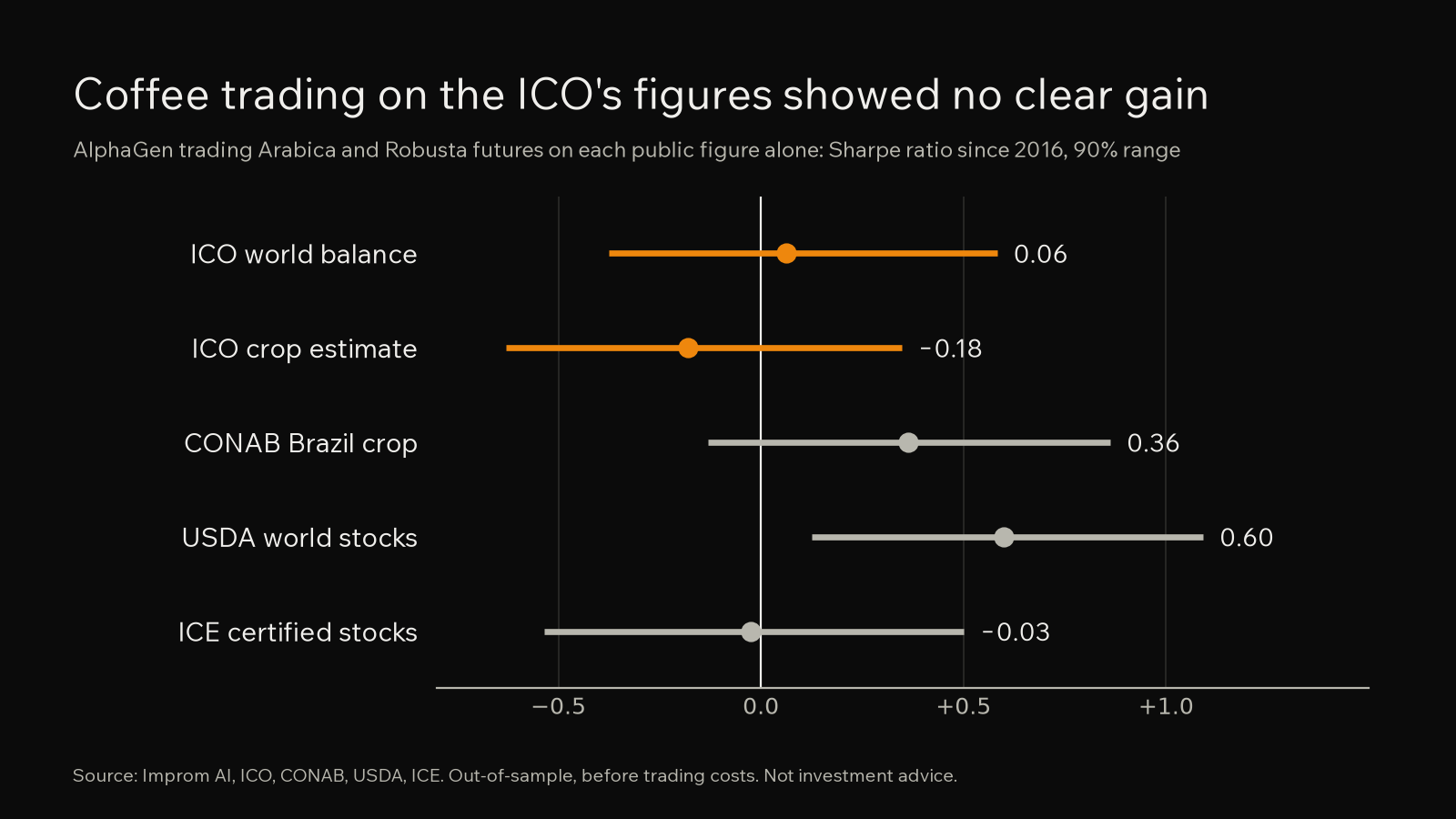
The ICO balance gave a Sharpe ratio of 0.06. Its range runs from −0.38 to 0.58: somewhere between a small loss and a modest gain, and we cannot tell it from zero. By market, Arabica gave −0.08 and Robusta 0.13.
The ICO's own crop estimates did not do better: −0.18, with a range from −0.63 to 0.35. Arabica gave −0.27.
Brazil's crop surveys pointed the right way. CONAB gave 0.36, with a range from −0.13 to 0.86. That range includes zero, and it rests on about ten years of four surveys a year. It is a lead, not a result.
USDA world stocks: the strongest lead, mostly from one position
USDA's world stocks gave a Sharpe ratio of 0.60, with a range from 0.13 to 1.09, the only one above zero. Robusta gave 0.56; Arabica 0.33, with a range from −0.14 to 0.81.
Most of that gain came in 2023–2024, from one long position, a bet on a rise, held on both markets from December 2022 to June 2025. Before 2016, the same approach found nothing: Robusta 0.01, Arabica −0.22.
We did not test it against simply holding a long position, other markets or the ICO. Earlier tests on USDA releases found no clear effect. So USDA's figure is the strongest lead we have, and still only a lead.
Certified stocks showed no gain, with losing years on Arabica
ICE certified stocks gave −0.03: no gain. Arabica gave −0.27 and Robusta 0.18.
On Arabica, the strategy lost every year from 2020 to 2024, most of all in 2024. Those years saw Brazil's frost of 2021, ICE's rule changes of late 2023 and early 2024, and Brazil's drought of 2024. We did not test any of them as a cause.
Later checks agree. The rule our own dashboard applies to these stocks gave −0.17. A second AlphaGen setting showed a gain on Robusta stocks in London, but that series was irregular before 2025, so it is only a lead.
Why the ICO's balance changes rarely
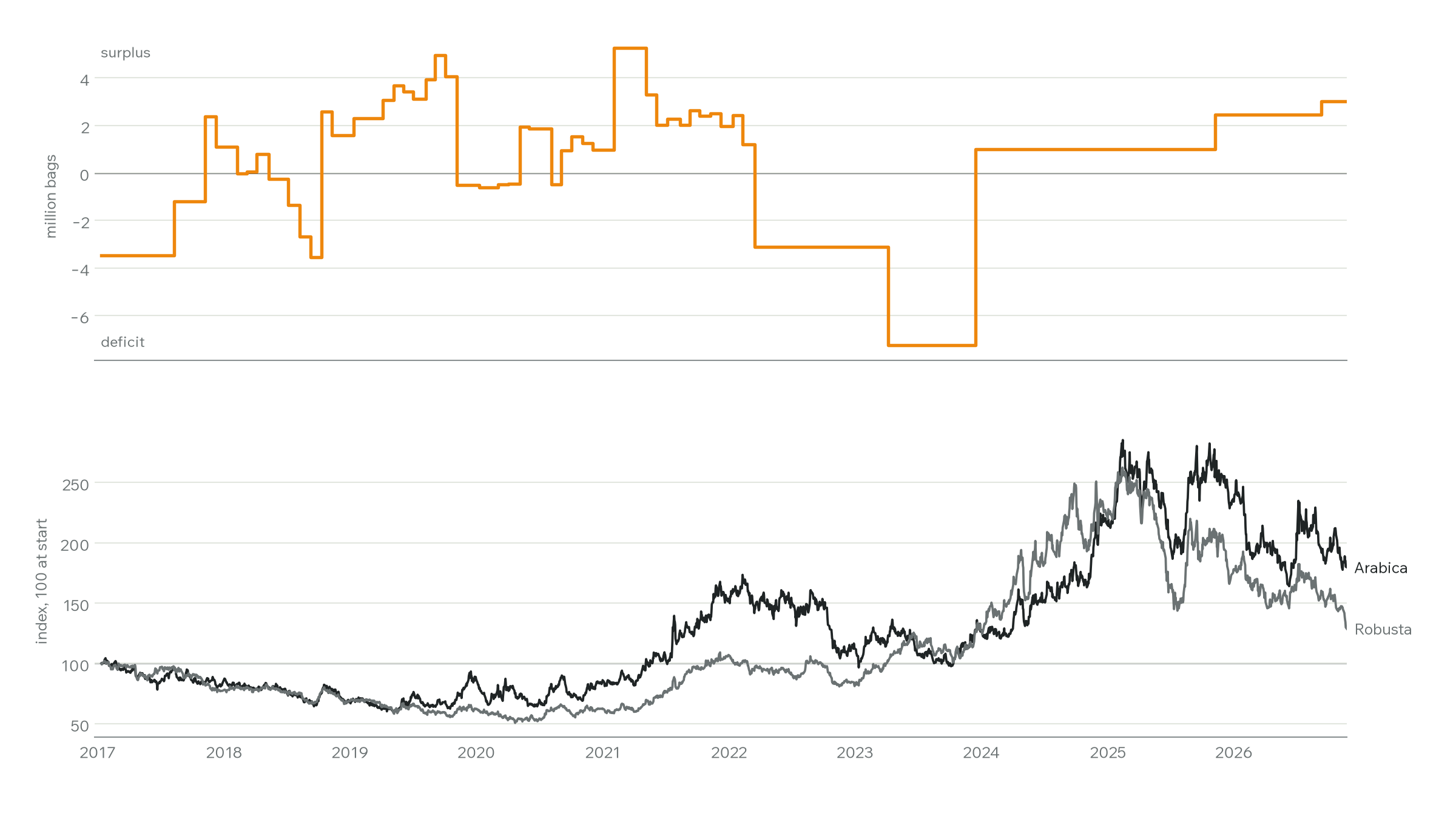
Top: the ICO's surplus (above zero) or deficit (below zero) for the newest coffee year in each report, million bags, by report date. Bottom: Arabica and Robusta futures, 100 on the first date. We did not test any link between the two panels. Source: Improm AI, ICO, ICE.
The rare changes do not explain our result: there was no gain before them either, with −0.11 in 2016–2021, a check made later. The drop in revisions began in 2022.
The line in the chart is the balance the ICO printed for the newest coffee year in each report. It moves when the ICO revises that year, and jumps when a new coffee year enters the table. In between, it stays flat. In our data, the table stopped at 2023/24 from the November 2023 to the September 2025 report. The 2024/25 balance first appeared in October 2025, after that year had ended.
In April 2023, the ICO launched "a new bi-annual report". The monthly table copied it from November 2023 at the latest, and no edition is listed in 2024/25. The ICO says its publications came "on time", in their "usual flow". What slowed is the balance estimate, not the reports. In 2025, its Head of Operations said statistics staff rose "from two to 3.6". No document we read says why the outlook ended.
What it means, and what it doesn't
The ICO's balance and crop estimates showed no clear gain, and the balance also became less frequent and less timely. Brazil's crop surveys pointed the right way; USDA stocks remain the strongest lead.
Our confidence is moderate: the ranges are wide. "No clear gain" does not prove that the ICO's figures carry no information. It means that, traded alone over this period, they did not show a gain that we could tell from zero. The two crop measures, from CONAB and the ICO, were added after the first results, not planned in advance.
This study describes the past; it is not a forecast, nor a trading rule. It says nothing about where coffee prices go after the 16 November report.
This article is for information only and is not investment advice or a recommendation to buy or sell any instrument. Results from back-tests are hypothetical: they are computed with hindsight, before trading costs, and do not reflect actual trading. Past performance does not predict future results.
Get the next one by email
Research notes on commodities signals — what we tested, what worked, and what did not.
Continue reading
Test your own variable on your own data
AlphaGen runs the statistical battery, the calibration and the risk-managed backtest for you — in minutes, not weeks.