Should cocoa traders follow El Niño?
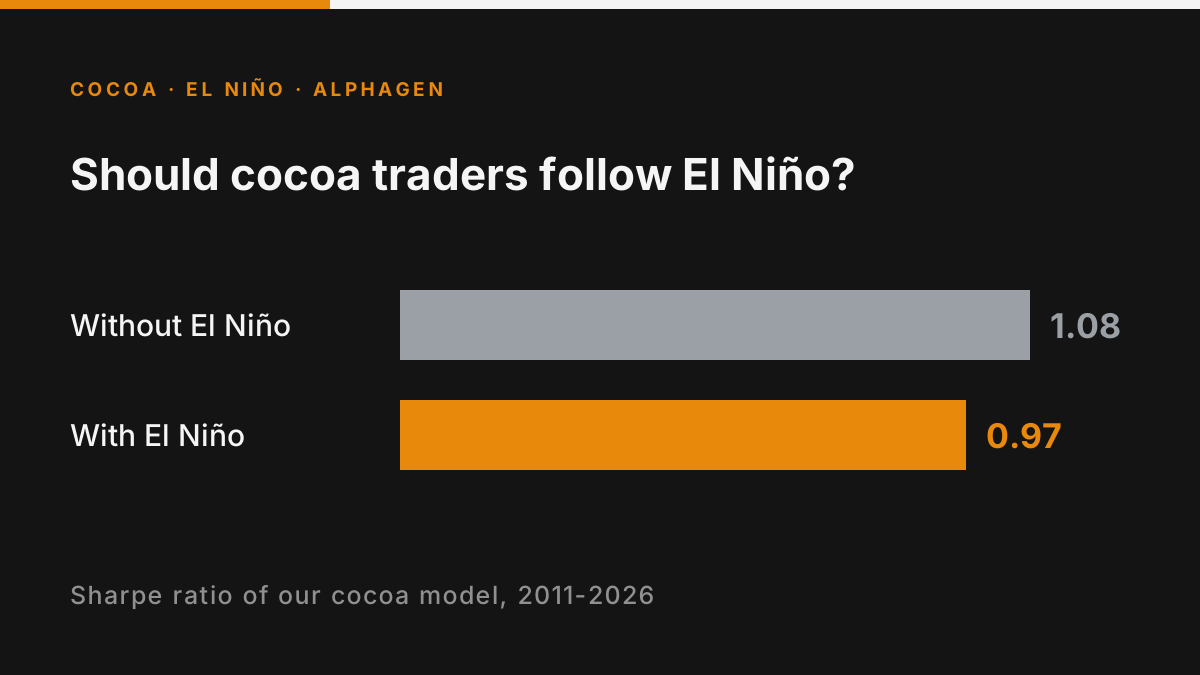
On 10 September NOAA put the chance of a very strong El Niño above 90%. We measured what El Niño told a cocoa trader since 2011: added to our cocoa model, it lowered the result, and the model did better with it in one season only, 2023-24.
Commodity Signal Review · 28 September 2026 · Geneva
On 10 September NOAA put the chance of what it calls a very strong El Niño above 90%. Adding El Niño to our cocoa model lowered its result from 1.08 to 0.97 over 2011-2026, and El Niño-only strategies lost on two of three measures.
El Niño is a warming of the tropical Pacific that shifts rain from some growing regions to others. On 10 September, with an El Niño Advisory in force, NOAA's Climate Prediction Center put the chance of what it calls a very strong event above 90%1. Economists find that El Niño lifts commodity prices as a group2; for cocoa, the European Central Bank found effects around zero3. World cocoa output fell 13.1% in 2023/24, during the last El Niño4. AlphaGen, our modelling tool, measured what El Niño told a cocoa trader about the next session's price, from 2011 to 24 September 2026.
The essentials
- Adding El Niño to our cocoa model lowered its result over 2011-2026, from 1.08 to 0.97. The model did better with El Niño only in 2023-24, the season of the last El Niño and of the crop failure (1.62 to 2.05); over every other year together it did worse (0.99 to 0.77).
- On its own, a strategy on NOAA's Relative Oceanic Niño Index (RONI) made money on cocoa (Sharpe ratio 0.12), all of it in 2019-2026; it lost in 2011-2018 (−0.19). Strategies on the other two El Niño measures lost.
- World cocoa output fell 13.1% in 2023/24; USDA traced Côte d'Ivoire's loss to heavy rain, then a Harmattan drought, on old trees with swollen shoot.
- The Harmattan, the dry wind of cocoa's 2023-24 drought, blows between November and mid-March. NOAA's next update is on 8 October.
Strategies on El Niño alone lost money on cocoa with two of its three measures
AlphaGen builds for each product a strategy that goes long or short each day from the variables it is given, recalibrates it on past data only, and measures what the strategy would have gained or lost. Each position uses only data known the session before, so every result from 2011 comes from data the model had not seen. The Sharpe ratio scores each strategy as its annual gain relative to the risk taken: positive, it made money; negative, it lost.
The first test used El Niño alone. Each day AlphaGen went long or short cocoa from one of NOAA's three El Niño measures, the RONI5, its change over three months or the older ONI, with the research's sign: a stronger El Niño lifts prices. Over 2011-2026 the strategy lost money on the three-month change (Sharpe ratio −0.14) and on the ONI (−0.02). On the RONI it made money (0.12): it lost in 2011-2018 (−0.19) and gained in 2019-2026 (0.43).
El Niño reaches cocoa through the crop. For 2023/24, USDA's attaché in Côte d'Ivoire reported excessive rain in May and June 2023, then a drought made worse by the Harmattan, the dry north-easterly wind that blows between November and mid-March, while swollen shoot, a virus that kills cocoa trees, spread through ageing plantations6. The report ties the rain to El Niño; it does not say so of the drought.
Our cocoa model did a little worse with El Niño than without it
The second test calibrated three other cocoa drivers, each alone, over 2011-2026; freight and fertiliser prices have data only from 2015 and hold no position before. They were kept because they made money: container freight (0.50), as dearer shipping raises importers' costs, a weak link; fertiliser prices (0.20), as dearer fertiliser lowers later yields; and the futures curve (0.26), which moves into backwardation, the nearest delivery month above the next, when stocks run short.
In the third test, AlphaGen calibrated our cocoa model7, 11 variables from ICE certified stocks and satellite readings of the canopy in Côte d'Ivoire and Ghana to grinders' margins, first as it stands, then with the RONI and its three-month change added. Over 2011-2026 it scored 1.08 without El Niño and 0.97 with it (chart below). With El Niño the model did a little better in 2019-2026 (+0.08) and worse in 2011-2018 (−0.31). All of that gain came in 2023-24, the season of the last El Niño and of the crop failure (1.62 without El Niño, 2.05 with); over every other year together, the model did worse with it (0.99 against 0.77). Adding the two El Niño inputs also changed the weights AlphaGen gave the other variables, so the difference is not El Niño's information alone, and each result is a single run.
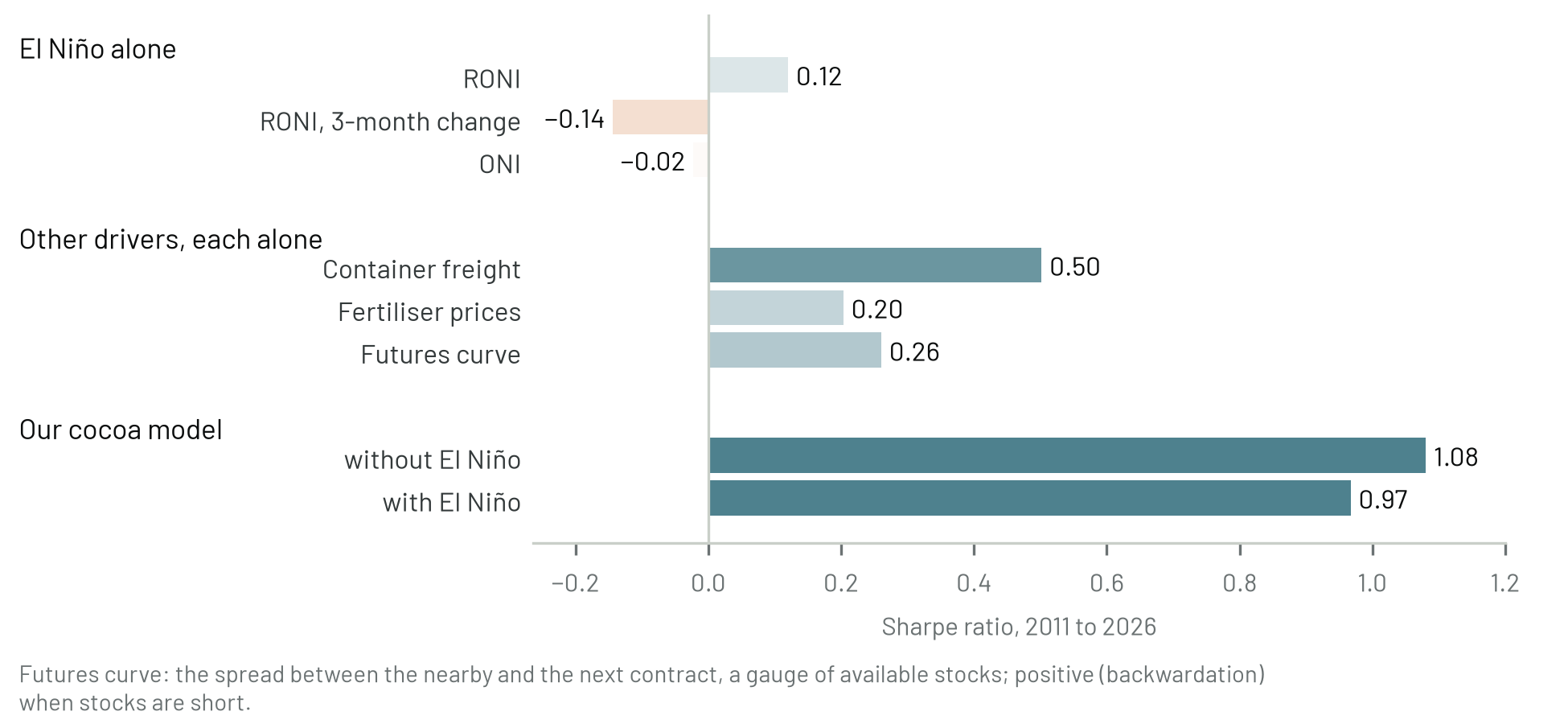
Sharpe ratio of the positions AlphaGen took on ICE cocoa, 2011 to 24 September 2026, judged on sessions after each calibration: above 0 the strategy made money for its risk, below 0 it lost. Top: each El Niño measure alone; middle: three of cocoa's other drivers, each alone (freight and fertiliser data start in 2015, with no position before), kept among those tested for a sourced mechanism and a gain (El Niño was not selected); bottom: our cocoa model, the variables we run in production recalibrated by AlphaGen, without and with El Niño. Every input at its previous-session value. Sources: ICE Futures U.S. and Europe, NOAA CPC, NewContex, GreenMarkets, Investing.com, the European Cocoa Association, Commodity3, NASA MODIS. Last observation: 24 September 2026.
The tests judge the next session's move. El Niño works on the crop over months, through rain and output.
What to watch this winter
Côte d'Ivoire's main-crop marketing season runs to 28 February 20278, inside the Harmattan season6. Any El Niño damage would show in crop estimates such as the ICCO's quarterly bulletin. NOAA's next El Niño discussion is due on 8 October1.
On this record, NOAA's odds are no reason to open, add to or time a cocoa position. A grinder or chocolate maker keeps its cover schedule; a risk manager treats El Niño as a crop scenario over months. That reading holds only while El Niño's gain in 2019-2026 (+0.08) stays small.
How we know
El Niño's sign was set from the research before any run. The model's other variables keep the signs we use every day. AlphaGen's second test: drivers picked from inputs already tested, for their mechanism and for how they did, then recalibrated alone. El Niño was not selected.
How this issue was built
Improm Atlas gathered the market record, and AlphaGen measured, on data it had not seen, how well each indicator anticipated each market. Talk to us about testing your own indicators.
atlas.improm.ai · alphagen.improm.ai · improm.ai
Note — Not investment advice.
Footnotes
-
NOAA Climate Prediction Center, 10 September 2026. ENSO Diagnostic Discussion ↩ ↩2
-
Allan D. Brunner, Review of Economics and Statistics 84(1), 2002. El Niño and World Primary Commodity Prices: Warm Water or Hot Air? ↩
-
European Central Bank, Economic Bulletin 6/2023, Box 1, September 2023. Risks to global food commodity prices from El Niño ↩
-
International Cocoa Organization, 29 November 2024. November 2024 Quarterly Bulletin of Cocoa Statistics ↩
-
RONI, the Relative Oceanic Niño Index: NOAA's measure of Pacific warming relative to the tropics as a whole. ↩
-
USDA Foreign Agricultural Service, 7 March 2025. Cote d'Ivoire - Cocoa Sector Overview - 2025 (GAIN report IV2025-0001) ↩ ↩2
-
Our cocoa model: the variables and signs we use every day to follow cocoa, rebuilt from the raw series. ↩
-
Sika Finance, citing a government note of 27 February 2026, 28 February 2026. Côte d'Ivoire/Cacao : Un nouveau calendrier pour relancer les achats et fluidifier les ventes ↩
Continue reading
The best way to trade the oil shock is a sugar contract
· 3 min
Test your own variable on your own data
AlphaGen runs the statistical battery, the calibration and the risk-managed backtest for you — in minutes, not weeks.